
A beer-colour number is a useful measurement, but it is not a complete description of what a beer looks or tastes like. The distinction matters when comparing a laboratory result, recipe estimate and image on a phone.
A single colour value does not describe the whole spectrum
SRM and modern EBC methods describe light absorbance at 430 nm, with the specified measurement path and method. The scale multipliers differ. The resulting number does not uniquely specify the beer’s hue or clarity.
Separate three kinds of information in your notes: a measured colour, a recipe-model estimate and a visual impression. A photograph under warm lighting is not an independent laboratory result.
For recipe comparisons, write down the source of the value. “12 SRM, software estimate” is a different claim from “12 SRM, measured finished beer”.
Section references: BJCP — Color Guide: technical background and viewing limitations.
Keep the unit attached to the number
The inverse is SRM ≈ EBC / 1.97 for these modern conventions. Do not apply the relationship to an unspecified historical method or treat malt colour in degrees Lovibond as the same measurement as finished-beer SRM.
| SRM | Approximate EBC |
|---|---|
| 2 | 3.94 |
| 5 | 9.85 |
| 10 | 19.7 |
| 20 | 39.4 |
| 40 | 78.8 |
Extra decimal places in a conversion do not make the original colour estimate more accurate. Round to a level that suits the source measurement.
Section references: BJCP — Color Guide: technical background and viewing limitations.
A glass and a screen are different viewing systems
Viewing depth, lighting and the comparison background affect visual judgement. The same beer can appear darker through a wider path. Even beers with the same SRM can differ in hue.
For a repeatable informal comparison, use the same glass, beer depth, background and lighting, and keep those conditions in your notes. Judge clarity separately from colour. A hazy appearance should not be turned into an invented correction to SRM.
A screen introduces its own brightness, colour settings and display variation; a printer adds paper and ink differences. Our artwork deliberately makes no claim that matching its patch establishes the beer’s SRM.
Section references: BJCP — Color Guide: technical background and viewing limitations.
An original illustrated conversion sheet
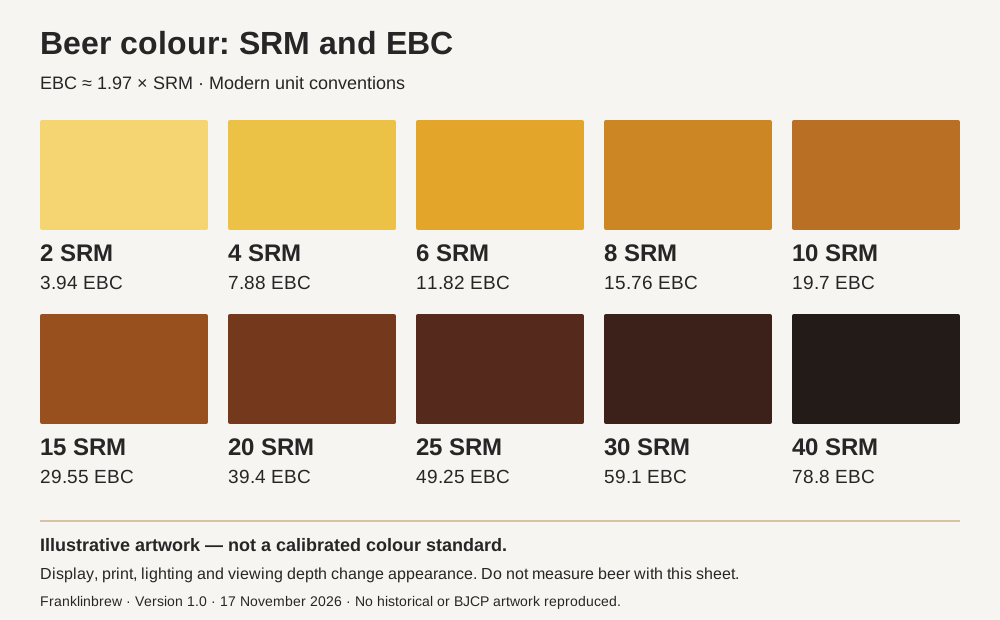
Download the original SVG reference for an offline copy. It contains editable vector text and can be printed, with the same calibration limitation.
This is new Franklinbrew artwork. It does not reproduce the former site’s srm.jpg or the BJCP’s calibrated colour guide.
Do not infer chemistry or flavour from darkness alone
Colour does not directly establish alcohol, bitterness, residual sweetness or mash-water requirements. A dark beer can have several different grist and fermentation histories.
When selecting a sugar or syrup, compare extract and flavour as well as colour. When adjusting brewing water, use actual water chemistry and grist information rather than choosing an alkalinity target solely from the beer’s SRM.
If your task needs measured colour, use the appropriate validated method or a suitable laboratory. This illustration is a reading companion, not a replacement for that work.
Sources & scope
References and review
Unit relationship and visual limitations were checked against BJCP technical guidance. Conversion examples were recomputed. Patch colours are original illustrative choices without spectral or print calibration; no historical graphic was copied.
Franklinbrew · Independently written reference · Version 1.0 · Reviewed 17 November 2026.